The Odyssey is Greek
I love a classic story—one that spans the ages. I don’t mind when those classic stories are made more accessible for the modern age. I know not everyone has studied older literature to understand the meaning behind those writings’ more complex language and style (often figurative and symbolic), different narratives (Classic authors often used non-linear timelines, multiple perspectives, or dense plots with many subplots), and historical, cultural references. However, I take issue with stories that change historical or cultural details to make these stories more accessible to modern society because you can’t change culture or history. This is often done in Hollywood to make a movie more appealing to a wider audience. Generally, movie-goers do not care as long as the movie is good—they will overlook the bad casting/writing, etc., if the movie overall is viewable. As a non-movie person, I ask: when are these changes too far for the audience to rebel against the directors, screenwriters, producers, etc.
One of the oldest stories in written history was The Odyssey, attributed to Homer anywhere between the 5th-9th centuries (scholars debate the exact dates as most Greek citizens were illiterate, so the poem was probably spoken first, along with The Iliad). No matter when it was first written, The Odyssey is wildly considered one of the most influential works of the Western canon. In 2018, when BBC Culture polled experts around the world to find literature’s most enduring narrative, the Odyssey topped the list. The Odyssey’s core themes—homecoming, cunning, divine intervention, and the trials of the journey—resonate across centuries and genres.
The poem is written in 24 chapters (debated to correlate with the 24 letters of the Greek alphabet) and tell the story of Odyssius. SYNOSPIS; Ten years after Troy fell, Odysseus has not returned to Ithaca, his kingdom. fall of Troy, and the Greek hero Odysseus still has not returned to his kingdom in Ithaca. His wife, Penelope, has been courted by many suitors, but has remained faithful to Odysseus. Prince Telemachus, Odysseus’s son, wants desperately to throw them out but does not have the confidence or experience to fight them. The beautiful nymph Calypso, possessed by love for him, has imprisoned him on her island, Ogygia. He longs to return to his wife and son, but he has no ship or crew to help him escape. While the gods and goddesses of Mount Olympus debate Odysseus’s future, Athena, Odysseus’s strongest supporter, resolves to help Telemachus. Disguised as Laertes, Athena helps the prince, and reveals his father is alive and trapped, Zeus sends Hermes to rescue Odysseus from Calypso. Odysseus heads home, but when Poseidon finds out, he sends a storm to wreck Odysseus’s ship. Poseidon has harbored a bitter grudge against Odysseus since the hero blinded his son earlier in his travels. Athena intervenes to save Odysseus from Poseidon’s wrath, and the beleaguered king lands at Scheria, where he receives a hero’s welcome. After he shares his tale, he returns to Ithaca, where Athena has disguised him as a beggar. However, Odysseus reveals himself to his son. Odysseus and Telemachus devise a plan to massacre the suitors and regain control of Ithaca. When Odysseus arrives at the palace the next day, still disguised as a beggar, he endures abuse and insults from the suitors. Eurycleia, his nurse, recognizes him, but promises not to reveal his secret. Penelope takes an interest in this strange beggar, suspecting that he might be her long-lost husband. After stringing his great bow, which only he can do, Odysseus kills all the suitors. Odysseus reveals himself to the entire palace and reunites with his loving Penelope. After one more attack, Zeus dispatches Athena to restore peace. With his power secure and his family reunited, Odysseus’s long ordeal comes to an end. A tale of Greeks: where the Greek comes out on top.
Since The Odyssey’s inception, there have been many adaptations of the epic poem, ranging from faithful retellings to radical interpretations—even some cartoons. While it is a story of fiction, The Odyssey and the Iliad formed the basis of education for members of ancient Mediterranean society. That curriculum was adopted by Western humanists, meaning the text was so much a part of the cultural fabric that an individual having read it was irrelevant (Hall 2008; Ruskin 1968). It is literature that has become part of history, which means you can’t change. The Encyclopedia Brittanica states history is, “discipline that studies the chronological record of events, usually attempting, on the basis of a critical examination of source materials, to explain events.” If we study Greek history, we must include The Odyssey as one of those source materials.
The newest adaptation of The Odyssey, Christopher Nolan’s film of the same name, drastically changes Greek history through the director’s desire to include chosen actors/actresses who do not fit in the definition of Greek history and mythology. The most glaring changes were made to two of the most important figures in the Greek story: Helen of Troy (Sparta) and Athena. Helen of Sparta was the daughter of Zeus and Leda and was considered the most beautiful woman in the world. When she married Paris of Troy, the Trojan War began. She was Spartan, so she would be tall, muscular, olive-skinned, and dark-haired, like most Greeks. In Nolan’s film, Helen is played by Lupita Amondi Nyong’o, a Kenyan actress, who has many accolades to her name. While a great actress and beautiful, she is not the beautiful, Greek Helen of Troy. Nolan changed her race and her background. None of this is true to Greek culture. Nyong’o opted to emphasize who Helen was beyond her appearance, stating, “You can’t perform beauty”. She added the cast was “representative of the world” while “occupying the epic narrative of our time.” Writing for The Guardian, Greek film critic Chris Cotonou called this an “honourable intention,” but argued it made the absence of Greek diaspora representation “even more glaring.” There were no Greek depictions in a Greek-inspired film. The Greek part of my heart aches at a re-telling of Greek history with no Greeks, and no one that looks Greek.
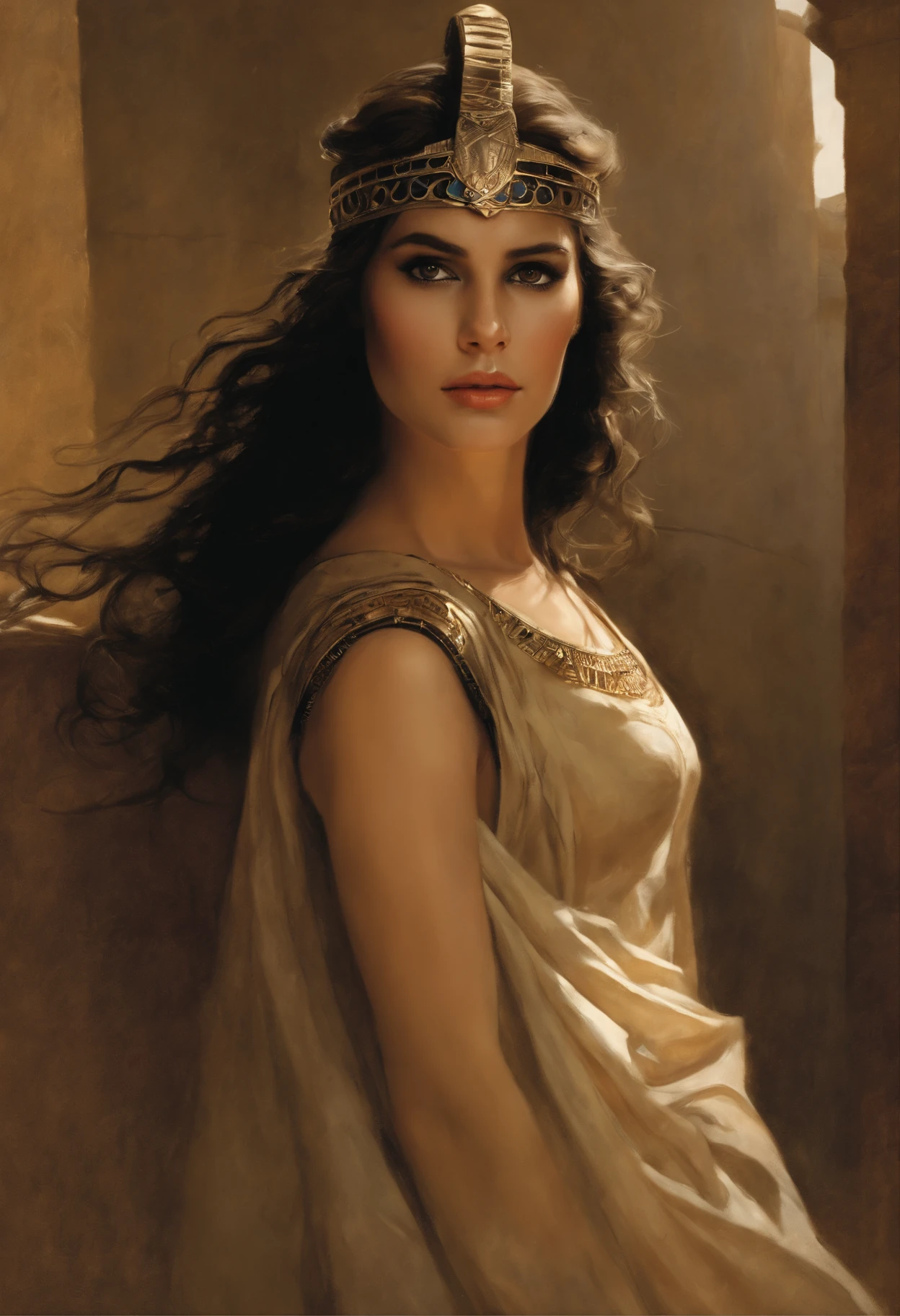
Athena, the Goddess of Athens, who was the favorite child of Zeus. She was the goddess of wisdom and war. Athena is traditionally depicted as a tall, majestic, and powerful goddess, wearing armor and a helmet, with striking eyes and fair hair, embodying wisdom and martial prowess. In essence, Athena looks like me, lol. However, in the film, she is portrayed by Zendaya, a African/Caucasian actress. Again, a beautiful woman, but she does not fit the historical context of Athena. Tasos Kokkinidis at the Greek Reporter declared “Nolan’s casting ignores the Hellenistic roots of these historical and mythological figures”. It would be like filming Black Panther and using Margot Robbie to play Okoye. This would not be authentic to the history and culture behind the story’s origins.

Nolan also added a character, played by Elliot Page, named Sinon, who was not in the original narrative, but borrowed from Virgil’s Aenid. Members of Odysseus’ crew were Asian and Latino, which would never have happened in an all-Greek society. Nolan also added a bard, played by Travis Scott, the rapper. Nolan included this character because he wanted to allude to how the Odyssey had been retold through oral poetry, which he analogized to rapping, Scott’s profession. This is more appealing to modern audiences, and honors current culture over antiquity.
Nolan made other choices, which deviate from Greek culture and history. The characters speak in American accents in modern-day language. There is little Greek spoken in the film. There were no Greek actors in the film (to me, a European descendant is acceptable because Greeks are European, though I would like to see someone who looked Greek play the main characters). Nolan used Viking longships as Greek warships (biremes and pentecomers), and the armor looked eerily similar to Batman’s Mask in The Dark Knight, another film Nolan directed. Military historian Bret Devereaux stated the film’s armor was “vaguely Greek-looking” and “evocative of classical armor” There were more authentic ships and armor that could have been used in the film. The film was filmed in many locations that weren’t in Greece, including Iceland, Morocco, Scotland, Italy, Western Sahara, Malta, and United States. The timeline of the film is not the same as the narrative, which to me isn’t a huge deal because the non-linear nature of the film often helps the story be clearer than the linear timeline of the narrative. The music was reflective of Albanian and modern influences. While many believe Nolan’s script is faithful to the original, more prominently featuring Odysseus’s faithful dog Argos; more interactions between Odysseus and Telemachus; humanizing the goddess and witch Circe to be unsettling yet sympathetic; and complicating the reunion between Helen of Troy and Spartan king Menelaus. These adaptation make the story more compelling for modern audiences.
I do not agree with every criticism I have read of the film. I do not believe Nolan purposefully intended to disregard Greek history and culture. However, his interpretation of The Odyssey did create contention and ill will.
I will admit, I have not seen the film, nor will I. 1—it’s 3 hours long. I am not a movie fan on a regular day, so a 3-hour long movie is a no for me. I do not care about the special effects or the type of cameras used (IMAX 70 MM). 2—I am not a Nolan fan, or his interpretations of things he has filmed in the past. I am a traditionalist. We are not meant to interpret every written thing in film. We are not meant to interpret history how we want and rewrite it using characters of our choosing (to me, this is what Nolan did. If he was writing his own story, we wouldn’t be having this discussion. He could write the characters how he saw them). In a world of cultural sensitivity, I find this movie culturally insensitive. Films like 300, Troy, and Gladiator were not historically accurate, but their creators also didn’t try to rewrite history with their interpretation of those events to change the culture or significance behind them. I saw 300 in Greece when it was released, and that was an amazing experience. We all knew there was more than 300 soldiers. Still, the Greeks chanted “THIS IS SPARTA” along with Leonidas. There was clapping and cheering. The movie celebrated Greece and Greek culture—as a story inspired by those things should. While Nolan tried to portray The Odyssey’s “foundational” nature as “it incorporates aspects of the horror, mystery, romance, and thriller genres of stories.” he did it choosing his favorite actors to portray historical characters and focused on the monetary value of the story. I cannot, in good conscience, support him or this film.
I do not begrudge anyone who chooses to see the movie. To each their own. I know people have different views of life and experiences influence our perspectives. Like many Greeks, I will purposefully choose not to watch, no matter how good critics say the film is. Στηρίζω την Ελλάδα
About The Author
