Empathy
No two people are the same, not even identical twins. We all have our own thoughts, feelings, upbringings, struggles, and life experience. How we relate to other people, and how we understand and share people’s feelings, our empathy—is a key to navigating the world. Psychology states there are 4 types of empathy, and it’s important to understand how you give, receive, and experience empathy in your daily life. The most significant relationship you’ll ever have is with yourself. Knowing your empathy style provides a basic understanding of how you can effectively express caring to yourself and others, and where you might be off balance and need to make some tweaks. Understanding your empathy style can help you love yourself more and find a comfortable, healing mode of giving and self-care.
Your primary empathy style — cognitive, emotional, intuitive, or spiritual — reflects how you most naturally express empathy to yourself and others. Of course, you may relate to other styles as well, your primary style is your default setting —how you express empathy most of the time. Knowing your style is the starting point for appreciating how your own empathy operates, and how you can comfortably give and receive care. It’s important to note that narcissists, and people with empathy-deficient disorders will not have an empathy style because they lack empathetic qualities. On the opposite end, is people who are empathicalists. Empathicalism became popular when introduced in 1957’s Funny Face. Audrey Hepburn’s character, Jo, runs a bookshop, and only agrees to become a model to attend lectures on empathicalism She wants to feel what other people feel. It is unrealistic to be fully empathetic; there must be a balance.

All styles of empathy are healing in their own ways. You must make the most of your personal assets, but you can experiment with different styles to incorporate different options. With most areas of life, there are advantages and disadvantages to each style of empathy. It’s essential to balance those empath styles. Remember: sometimes empathy means doing nothing at all. The key is knowing when to act and when to let things lie.
Style 1. Cognitive Empathy: The Thinker/Fixer
If your primary empathy style is cognitive, you’re most comfortable with a concrete, cerebral approach to emotions. (Like me!) This style can be considered the “thinking empathy.” You use your mind to understand others and wish the best for them. You are solution oriented. You want to logically fix a problem with brain power but are frustrated if you can’t. You may respond to a friend in distress and offer solutions, but you do not try to fix the problem for the other person; you listen, process, and then give them the space to resolve the problem. You understand their pain, but you don’t take the pain as your own burden.
Style 2. Emotional Empathy: The Feeler
If your primary empathy style is emotional, you empathize with others through your emotions. You feel their pain with them. Consider this style “feeling empathy.” You have a big heart and are responsive to people’s needs. You feel everything, but sometimes to an extreme. Some emotional empaths may be an emotional sponge whose body absorbs others’ distress as well as their joy. Emotions can be contagious, so you need to be conscience of “catching” other people’s feelings. People who are emotionally empathetic need to be conscience because carrying around emotions may be detrimental to your physical and mental health.
Style 3. Intuitive Empathy: The Subtle Senser
If your primary empathy style is intuitive, you use your keen intuition and sensitivity to help you read people’s nonverbal cues and body language. Intuitive empathy is considered the “sensing empathy.” Intuition helps you use your senses to tell if someone is being authentic or not. Intuitive empathy allows you to use your strong unconscious feelings and a-ha moments, inner-knowings or dreams to help you understand people and emotions better. Intuitive4 empaths also feel the positive and negative energy that people send out.
Style 4. Spiritual Empathy: The Mystic
If your primary empathy style is spiritual, you empathize with others through your spirituality. This style is considered “divining empathy,” which describes the process of connecting to spirituality. Waajman (2000) defines spirituality as, the “religious process of re-formation which aims to recover the original shape of man” oriented at “the image of God” as exemplified by the founders and sacred texts of the religions of the world. Spiritual empaths use spirituality to open their hearts. Because spirituality is experienced in different ways, people connect with God, Goddess, nature, a creative intelligence, or the power of love. The divine is a steppingstone to your larger, compassionate self. Your body is the vessel for your spirituality as you give and receive empathy.
Researchers from The University of Michigan have conducted studies, in which they analyzed data between 1979-2009. These studies indicated empathy towards others has dramatically declined over the years. Researchers say there has been a 40% decline in empathetic concern over the years. “We found the biggest drop in empathy after the year 2000,” said Sara Konrath, researcher from the U-M Institute for Social Research. Researchers suggest over-exposure to media that contains negative, violent images, which might lead to apathy about pain others are experiencing. The rise of the Internet and social media has created what some call “Generation Me,” a self-centered group of young people that Konrath and her colleagues believe might not have time nor the inclination to stop their busy lives to empathize with a friend.
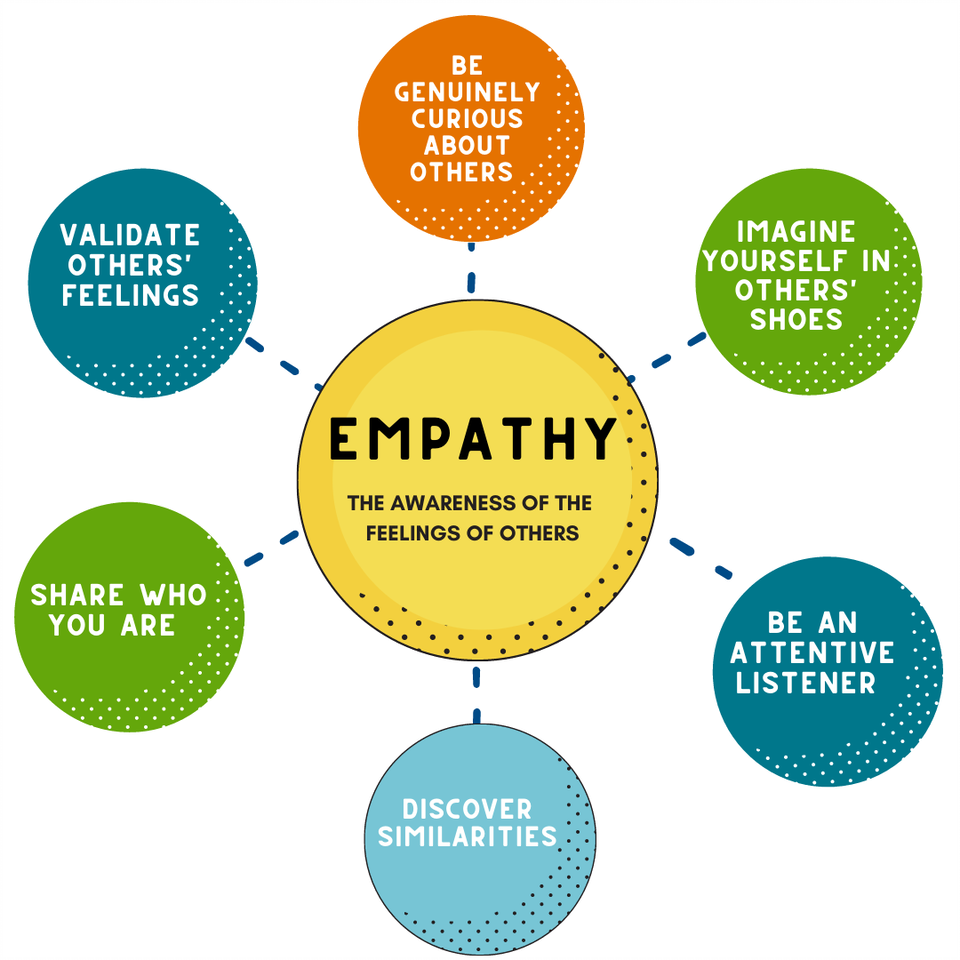
Dr. Kara McLaren has stated there are 6 essential characteristics of empathy, and empathy can be developed at any time in our life. Those 6 characteristics are:
- Emotion Contagion (or Emotional Awareness): you need to understand an emotion is occurring, and when an emotion is expected from you. Empathy relies upon your ability to detect, feel, and share emotions. Empathy is first and foremost an emotional skill.
- Empathic Accuracy: Skilled empathy is based on your ability to accurately identify and understand emotions and intentions in yourself and others. Once you are aware of your emotions, you can understand them, and you can respond to those emotions appropriately.
- Emotion Regulation: You must recognize, understand, and work with your own emotion, and need to be self-aware. When you can identify and regulate your emotions, you’ll be skillful in the presence of strong emotions rather than being overtaken them.
- Perspective-Taking: This skill helps you put yourself in the place of others, understand their place, and accurately sense what they might be feeling. This will clearly understand from their perspective what they need or want. Assuming what they want /need is not empathy but generosity.
- Concern for Others: The quality of your emotional response depends on whether you care about others or not. Your authentic concern will help you engage and empathize in a way that displays your care and compassion.
- Perceptive Engagement: This is your ability to respond empathically to others. This full expression of empathy is dependent upon the first five aspects, and it helps you respond or act* wisely. Perceptive engagement helps you clearly understand others’ feelings, desires, and needs so that you can empathize skillfully while respecting your feelings and needs as well.
Empathy is truly hard to define and pinpoint how it functions in real life. We know it’s more than compassion, but it’s hard to pinpoint exactly how empathy works. Empathy isn’t concrete. We can improve our empathy for others and ourselves. Empathy is best described as an interaction (instead of a trait) because when people tend toward high empathy, they can face situations that drop their empathy to zero. This is different for every person. Empathy is changeable and is situation specific. According to Dr. Elizabeth A. Segal, “Empathy is the ability to share the feelings of others, understand what those feelings may mean, and doing so with enough self-reflection to remain emotionally balanced. Empathy requires that we can clearly differentiate between our own feelings and those of others. The balance of empathy takes strength, it is a skill and ability of those who are centered and strong.” Empathy is not easy. It takes determination to have solid boundaries, balanced emotions, keen awareness of our surroundings, and adequate awareness to see the world through other’s eyes. Empathy is a lifelong skill to have, and it’s not for the faint of heart.
About The Author
