Hope is Everything!
Have you ever woken up in the middle of your sleep, and just felt sad, but you don’t know why? This happens to me frequently. I will wake up crying. Or I will feel down in the middle of the day. I consider myself a matter-of-fact person—I am neither an optimist or a pessimist, so things are the way they are—the world is negative, so my viewpoint of it is more on the negative side. I am a rational person, and my sensibility guides my life. I am working on having a more positive outlook.
My favorite word in the English language is hope. Hope is an optimistic state of mind that is based on an expectation of positive outcomes with respect to events and circumstances in one’s life or the world at large. As a verb, its definitions include: “expect with confidence” and “to cherish a desire with anticipation.” Everything about hope exudes positivity and positive feelings.
In 2018, Dierks Bentley released his album The Mountain. A song from it called Woman, Amen, which he is singing the virtue of the women in his life states, “She gives me faith, she gives me grace / She gives me hope, she gives me strength / She gives me love, love without end.” All the words in the song are positive: faith, grace, hope, strength, and love. When the album came out, if you were in Dierks’ Fanclub, you could receive a key with one of the words from the song engraved on it. I, of course, chose HOPE. I put the key on my keychain, so I can always carry hope with me.

Hope is more than to believe or to wish; it’s a knowledge/belief deep within your heart. Professor of Psychology Barbara Fredrickson argues that hope comes into its own when crisis looms, opening us to new creative possibilities.[4] Frederickson argues that with great need comes an unusually wide range of ideas, as well as such positive emotions as happiness and joy, courage, and empowerment, drawn from four different areas of oneself: from a cognitive, psychological, social, or physical perspective
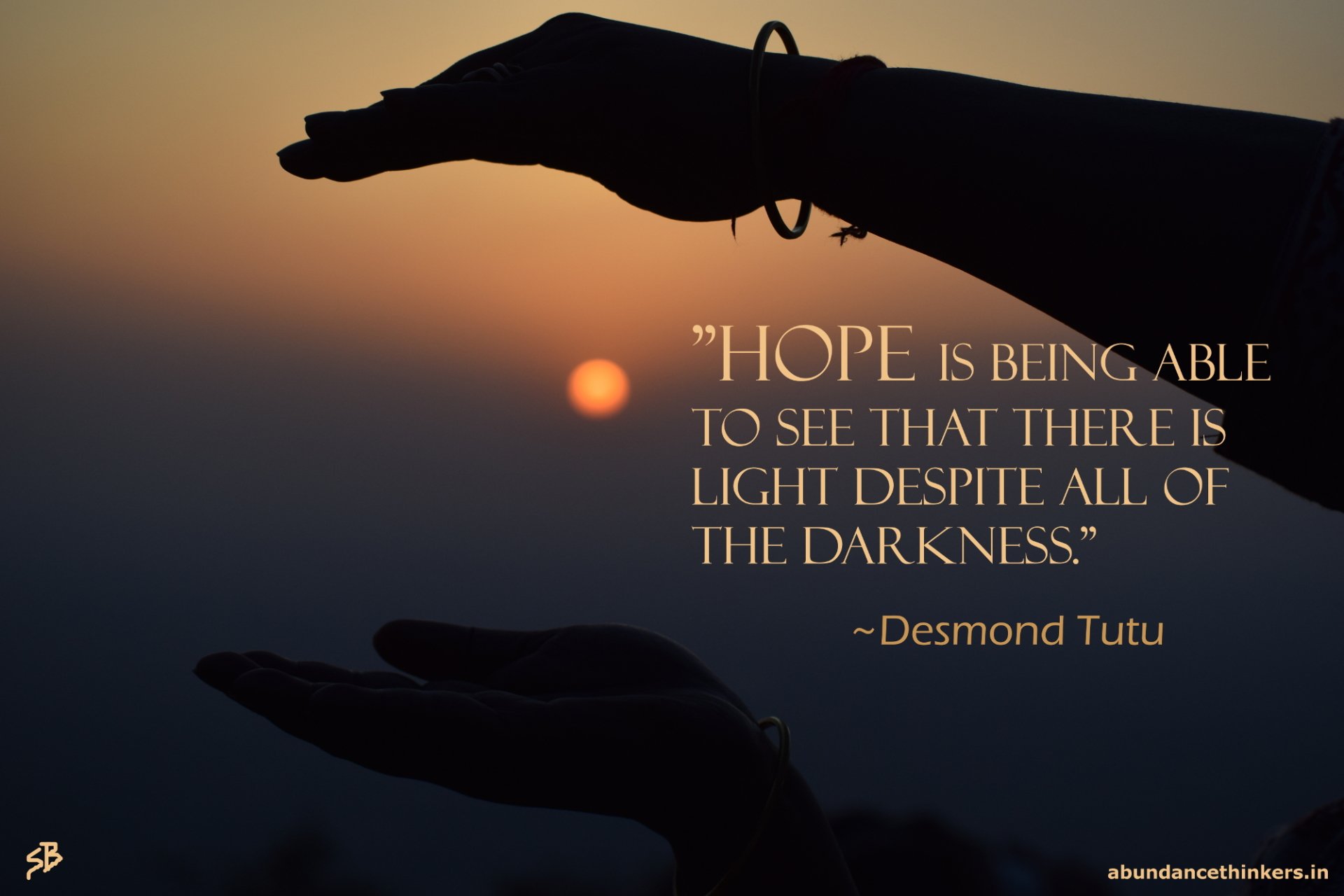
If I could find a way to bottle hope and create an elixir, I would pass out a bottle to everyone I knew. Hope is more powerful than any antidepressant on the market. Hope is often the only thing between a person and ultimate despair. Hope saves us from the abyss—it is the light amidst the darkness. If a person has hope, they can get through anything. If one loses hope, they lose everything. If you lose hope, you need to find a way to get it back. Hope is an emotion that arises from the heart, not the head.
Hope is always within us—it lies dormant in our inner spirit until we need it. To hope is to have an amazing power—a strength that you can and will overcome anything that comes into your life. Hope reminds us that everything is okay, and that if we are going through a tough time, our circumstances will get better. Even though I am very logical, I always believe things will get better. I know that the wait takes longsuffering and patience, but things always work out the way they are meant to work out.
Professor of Psychology, Barbara Fredrickson argues that hope comes into its own when crisis looms, opening us to new creative possibilities. Frederickson states that with great need comes an unusually wide range of ideas, as well as such positive emotions as happiness and joy, courage, and empowerment, drawn from four different areas of oneself: from a cognitive, psychological, social, or physical perspective. We need hope to survive. No matter how big or small, hope tells us things will be better.
Hope turns the victim mindset into the survivor mindset. Hope empowers us to face the toughest times of our lives and come out on top. Hope has three components that are vital:
Faith- the belief that there is something bigger and more important than us. No matter what that thing is. The Universe. God. A higher power. A loved one. Mother Nature. Faith gives us a reason to go on, and it’s not just for you.
Gratitude-focus on what you have to be thankful for, not what you don’t have, or what you have lost, and what you want. (Wanting things is good, but it shouldn’t be the focus of our lives). Gratitude helps us live in the present. Remind yourself of the things you are thankful for everyday; a gratitude journal is a great way to do this. I use my gratitude journal to write down 5 things that I am thankful for each day. It’s really helped me focus on the positive. I write down my 5 every night before I go to bed. Sometimes the list is simple. Sometimes it’s complex.
Love-think about the people you love, and the people who love you. Make it a point to connect with those people regularly. Doing so in person is better, but a call/text/letter works too.
When you go through times of stress/anxiety/pain, hope reminds you “this too shall pass.” Hope is the opposite of doubt. Charles R. Snyder, an expert on positive psychology postulated that there are three main things that make up hopeful thinking:
Goals – Approaching life in a goal-oriented way.
Pathways – Finding different ways to achieve your goals.
Agency – Believing that you can instigate change and achieve these goals.
Contemporary philosopher Richard Rorty understands hope as more than goal setting, rather as a story that serves as a promise or reason for expecting a better future. One needs to be weary of false hope, no hope, and lost hope. Hope is a crucial and inherent part of existence. In the words of Emily Dickinson, “Hope is the thing with feathers that perches in the soul and sings the tune without the words and never stops at all.” We can’t always explain what hope is, but we know what it is deep within ourselves.
Hope has been a concept written about in literature for centuries. Alexander Pope’s Essay on Man states, “Hope springs eternal in the human breast / Man never is, but always to be blest:” Hope is always a blessing within us. Hope can be used as an artistic plot device and is often a motivating force for change in dynamic characters. Hope is often an anchor, a swallow, or a dove in literature.

Hope was a concept often referenced in Grek mythology. According to Friedrich Nietzsche, “Zeus did not wish man, however much he might be tormented by the other evils, to fling away his life, but to go on letting himself be tormented again and again. Therefore, he gives Man hope, —in reality it is the worst of all evils, because it prolongs the torments of Man.” While his view is not positive of hope, he does say Zeus created it to test man. From ancient times, people have recognized that a spirit of hope had the power to heal afflictions and helps them bear times of great suffering, illnesses, disasters, loss, and pain caused by the malevolent spirits and events. Greek writer, Hesiod, the personification of hope is Elpis. Hope also exists in Norse mythology as Von.
Hope is a key concept in most major world religions, often signifying the “hoper” believes an individual or a collective group will reach a concept of heaven. Depending on the religion, hope can be seen as a prerequisite for and/or byproduct of spiritual attainment. In Judaism, hope is trust/expectation. Hope is one of the three theological virtues of Christianity, along with love and faith. In modern terms, hope is akin to trust and confident expectation. In historic literature of Hinduism, hope is referred to as Pratidhi or Apêksh. It is discussed with the concepts of desire and wish.
Truly, hope is all around us, and can benefit our physical, emotional, and mental health. Hope sustains us in uncertain times. Hope is an optimistic state of mind that is based on an expectation of positive outcomes with respect to events and circumstances in one’s life or the world at large. As a verb, its definitions include: “expect with confidence” and “to cherish a desire with anticipation”. We all need hope in our lives—if we have hope, we have everything.
About The Author
